

Bafflement with Bezos

The whole debacle of the Washington Post brand hara-kiri last week dispatched the myth that a tech billionaire could save serious journalism. Jeff Bezos’s purchase of the paper in 2013 was greeted with euphoria, not just because he was a big fat wallet who would absorb the losses, but because we thought his Amazon wizardry was transferrable to journalism’s battered business model. The man was a digital titan, for god’s sake. He started selling books online from his Bellevue, Washington, garage and built it into a $2.2 trillion dollar consumer nirvana, with a Blue Origin side hustle of suborbital rockets. Surely he would figure out innovative new ways to connect the Washington Post’s rigorous reporting with hungry new audiences.
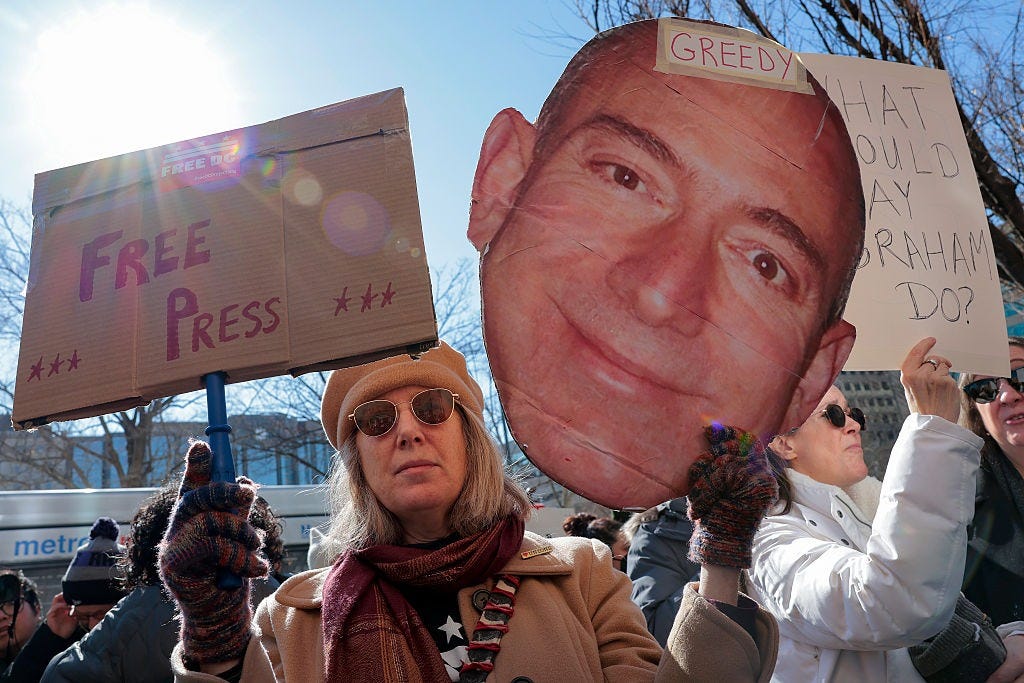
But last week’s flaming self-immolation—when the Washington Post staff was summarily cut by a third, including 300 newsroom journalists, its sports and book sections tossed overboard (this, from the world’s preeminent bookseller), and its foreign coverage gutted—revealed the stark truth that Bezos doesn’t understand how to run a news organization any more than Woodward and Bernstein could figure out how to deliver dog kibble to your door by drone. His statement last week doubled down on his enduring misapprehension. “Each and every day our readers give us a roadmap to success,” he proclaimed. “The data tells us what is valuable and where to focus.” No, it’s not the data that tells us, Jeff. It’s the intellect and enterprise of journalists searching out stories that readers didn’t know and editors who push them to do so. It’s beating the competition with holy-fuck scoops that make readers stop what they are doing and start firing up their text chains. It’s excavating the way we live today with preemptive insights that readers have only just begun to identify themselves. Daniel Keel, founder of a successful international book publishing house, once said about the fight against deadening data enslavement: “Reason and rationality may be pursuing us, but we are faster.”
The fashion to write off legacy media as a dinosaur trade extinguished by the headwinds of change fails to ask why Wall Street Journal editor-in-chief Emma Tucker was able to crisply revitalize that paper of record, and pay attention to data as an index of engagement, without the lumbering incompetence exhibited at the Washington Post. Or how New York Times CEO Meredith Kopit Levien, working with consistency and care alongside publisher AG Sulzberger and executive editor Joe Kahn, keeps rolling out a coolly considered audience-first strategy with a monster 12.7 million subscriber base.
O, Crappy Day
Bezos, however, turned out to be a master of disaster when it came to building a leadership team at the Post. Even the formidable editorial muscle of Marty Baron (hired by the last Graham family publisher Katharine Weymouth) could not cover up forever the flaccid business management of Bezos’s CEO/publisher appointment Fred Ryan, a Reagan-era Washington establishment figure who was the wrong member of Politico’s top tier to steal. Ryan’s hiring binge, triggered by the Trump bump, was reminiscent of the cratered Peloton strategy to bank on the permanence of the Covid at-home exercise boom. To replace Ryan, Bezos became dazzled by one of the media industry’s biggest con artists: British newspaper buccaneer and former CEO of Dow Jones, Sir (an honorific bestowed by fellow bloviator Boris Johnson) Will Lewis. I was stunned when I learned that Lewis was in the running to lead the Washington Post. How would the Post, whose newsroom suffers from something of a priesthood complex, tolerate a leader accused of destroying some 26 million emails in the UK phone hacking scandal at Murdoch-owned British newspapers, and worse (if your job is to win newsroom trust), handed over a cache of emails from tabloid journalists to the Met Police, in a mass betrayal of all their sources? That decision rendered him such a hated figure among the journos that, for a time, it was considered too dangerous for Lewis to enter the Murdoch HQ in London. Yet Lewis apparently convinced Bezos all this was no impediment to hiring him. It was “an old story.” (Yeah, like that old Epstein story.) Sure enough, in May 2024, Lewis fell afoul of the Post newsroom when he tried to quash its coverage of his appearance in new developments in the phone hacking scandal and he never regained its trust.
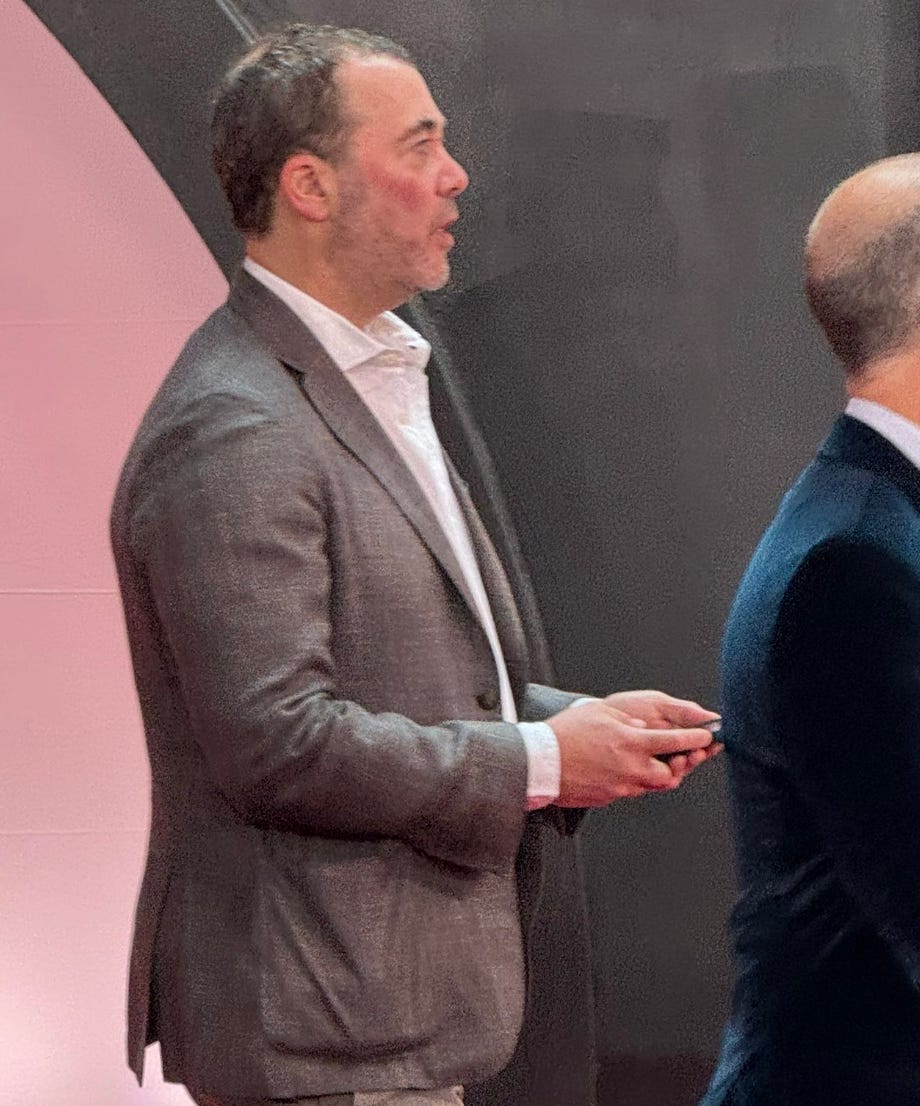
Lewis’s red-carpet appearance at a Super Bowl pre-party the same week as the bloodletting at the Post stunned even Post editor Matt Murray, who assumed he was in his office upstairs. But the junket schmooze was always Lewis’s MO. Flashing around Davos and Cannes Lions, he treated newsroom journalists as Pulitzer peons, set dressing for CEO boasts and toasts. His jargon-laden PowerPoint presentations were a sham. One all-hands meeting featured a puzzling bow-tie-shaped graphic that was supposed to show how the new, improved Post planned to build subscriptions. “To this day, I don’t understand it,” star Post sports columnist Sally Jenkins (now absconded to The Atlantic) told me. “Some people were like, ‘Is that a bow tie? Is that a funnel? What is that?’… It was always meetings, meetings, meetings, talk, talk, talk, charts, charts, charts, nothing, nothing, nothing.”
Why did Bezos allow Lewis to fail and flail for so long? One cannot imagine him tolerating such incompetence at the ruthless machine that is Amazon, where his handover to CEO Andy Jassy in 2021 was handled so flawlessly. The answer can only be that, by that time, Bezos didn’t much care.
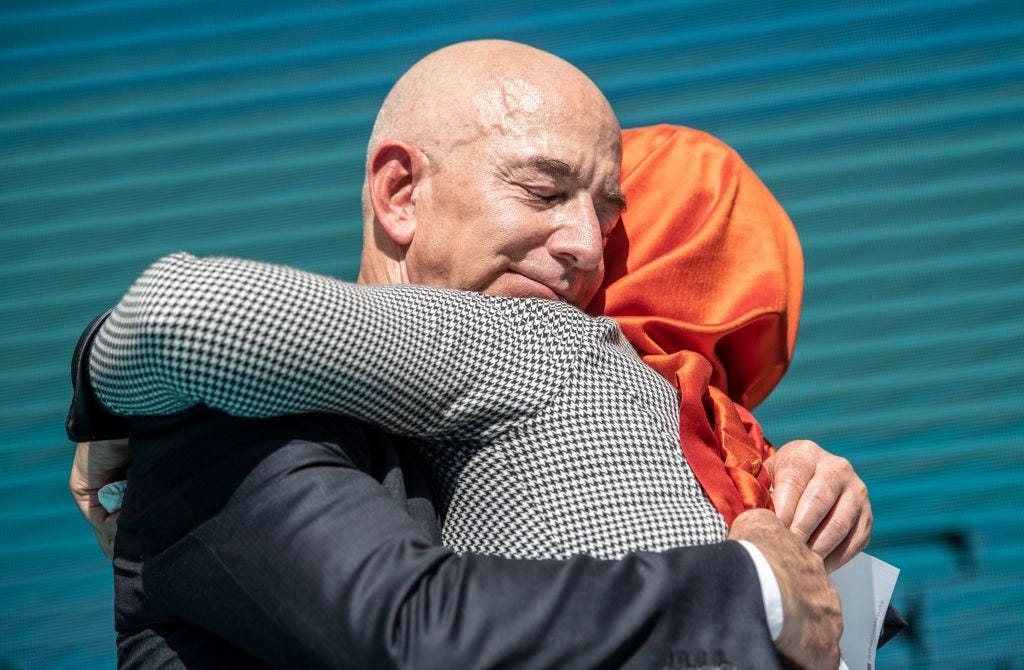
Throughout Trump’s first term, Bezos was a staunch steward of Post values, sucking it up when the paper’s tough Trump coverage resulted in the loss of a $10 billion dollar defense contract to Microsoft. He sent his plane to Tehran to collect Post correspondent Jason Rezaian after 18 months of incarceration on false espionage charges. Bezos risked MBS’s wrath by speaking at a vigil for murdered Post columnist Jamal Khashoggi. In 2019, Bezos wrote, “My stewardship of the Post and my support of its mission, which will remain unswerving, is something I will be most proud of when I’m 90 and reviewing my life.”
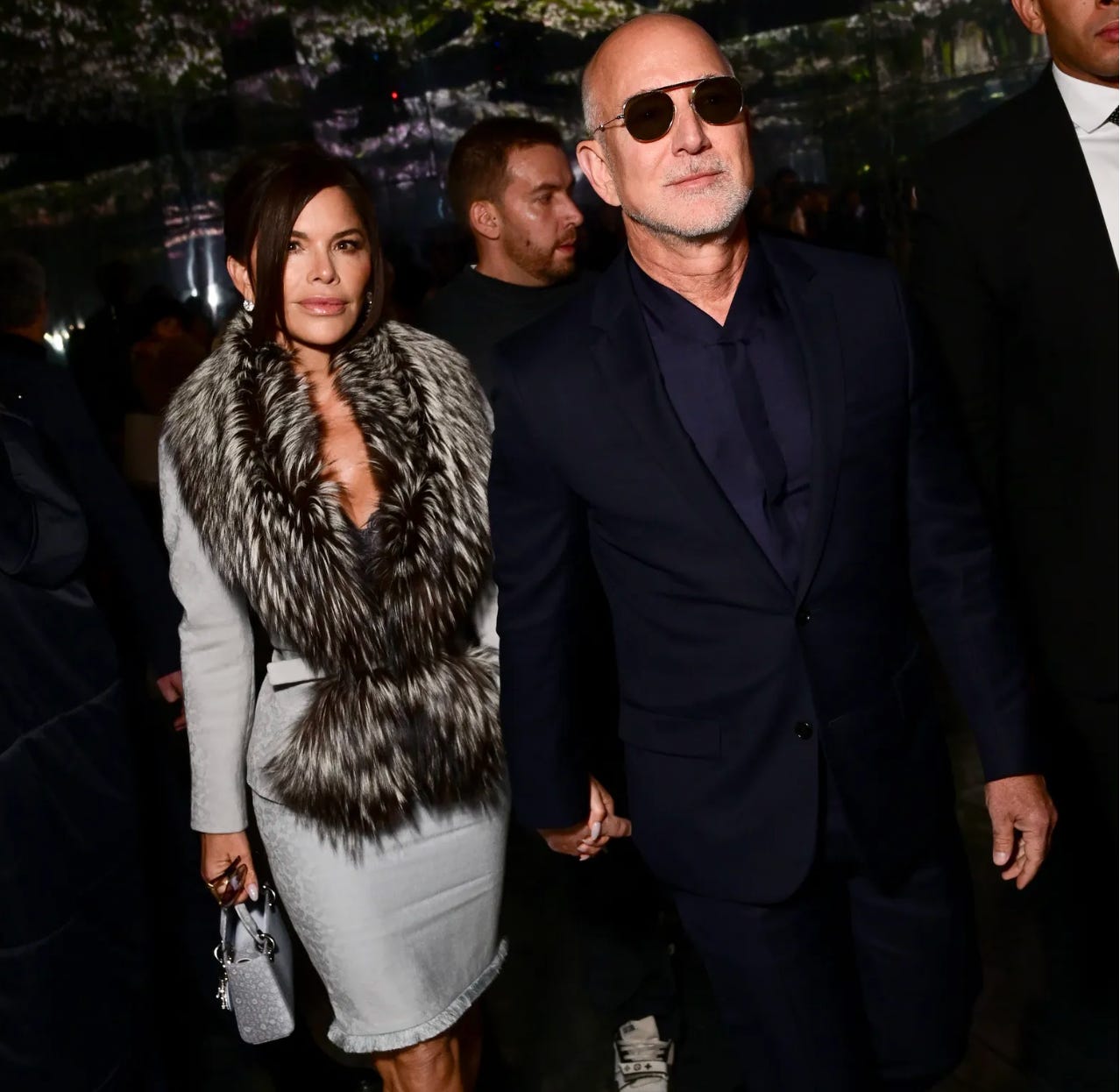
Yet he appears to have checked out of the Post some time after his libido was liberated by his pneumatic new paramour Lauren Sánchez. And that personal transition coincided with an acceleration in wealth that saw his net worth rise from $28 billion in 2013 to $222 billion today. You might think a fortune that stratospheric would make it easy to say no to paying out $75 million to make and market a Roman tribute to Melania. Or not feel the need to curry favor with Trump by precipitously ending the Post’s 36-year tradition of endorsing presidential candidates, just 11 days before the 2024 election, a decision that instantly lost the paper 250,000 hard-won subscribers. Entertaining War Sec Pete Hegseth at Blue Origin, two days before the Post apocalypse, and saying nothing about Hegseth’s Pravda-like restrictions on Pentagon press coverage, was not a great look either. The purpose of having f##k you money is to say f##k you, but it seems the purpose of f##k you money is to have more f##k you money.
Beautiful Dreamers
What’s baffling is that Bezos really was a tech visionary, and, in fact, so many of that first generation or two of tech bros were. Google’s Sergey Brin and Larry Page transformed forever the way we tap into the riches of the world’s information and learning. Elon Musk made environmentally-friendly electric cars that were fast and beautiful and promised us that his rockets would take us to Mars. Even Travis Kalanick, the rapacious CEO and co-inventor of Uber, invented a way for us to never be stranded. But as all the nerdy dreamers bulked up into heedless plutocrats, it was like watching a chart of the Descent of Man—their muscles bulged to comic-book proportions, their aspirations coarsened, they hid out in their luxury, Blue Zone caves. I think most of them had set out with a genuine belief that tech could make the world a better place, but they wound up instead wanting just to better their OWN place.
The Jeff Bezos who bought the Post was a different guy from the one who is allowing its destruction now. But oligarchs gonna oligarch. And if your motto is “Move fast and break things,” it turns out that a lot of what gets broken is what the rest of us value most.
Absolutely brilliant. Virtuosic, as always. Can you be in charge of all the news rooms?
Valerie Grove
'But oligarchs gonna oligarch.'
So true.
Tina you are the best!